This might be a lengthy post.
The reason I
still haven't written about Singapore is that 1) a lot of stuff has been happening here too and 2) probably the most "Singaporean" and interesting meal (hint hint: CHILI CRAB), I didn't attend. I still feel that it's worth blogging it, so I have to convince one of my parents to write a little description.
Anyways, these pasta lessons, that were given to me by Patrizia, were given in two parts, but I decided to put them together. The first time we made tagliatelle, which my mom and I then took home. The second lesson (yesterday) was much more complicated and enjoyable, because it also included cooking: we made spinach ricotta tortelloni and vegetarian lasagna, which our families then ate together.
This post will be like a tutorial. I'll start with the tagliatelle. First of all, let me just say that Patrizia grew up in Bologna, where everything was impeccably fresh (her parents still live in a little house in the mountains over there)-- in fact, she didn't have factory-made pasta (i.e. spaghetti) until she was in her TWENTIES!
My friend Bea was there for the tagliatelle, but not so much for the second cooking lesson.
1. Tagliatelle-- Making the dough was much simpler than I would have thought. All you need is flour (wheat, not semolina, which is too hard) and eggs. No water. That's it. You pour yourself a pile of flour (we just eyeballed it). Then you dig yourself a little hole in the center of your pile and push outwards to make it bigger. This can all be done on the kitchen counter. Then you crack three eggs into the center and start to beat them into the dough with a fork. You want to gradually start beating outwards so as to incorporate the eggs into the flour. When the flour-egg mixture is no longer running, you can start using your hands to knead it together, adding more


flour if it's too sticky.
Now you begin the kneading motion. Use your right hand to fold the dough over towards you, then use the heel of your hand (is that a word in this context) to PUSH outwards. Now use the same part of your left hand and PUSH again. The dough should be elongated, facing you horizontally, like a baguette. Now turn it so that it's vertical, and use your right hand to fold it towards you again. Once you get into the motion, you start to use your whole body-- I don't think I ever got that far, but for Patrizia, this motion is as natural as brushing


your teeth or toasting a piece of bread.
The dough will begin to harden, but it should still remain pretty soft. You should be able to tell when you don't need to knead it anymore. It should stay in a loaf-like shape, and should have a homogeneous texture.

The next step is to slice the loaf into about two-inch thick pieces (we used a Chinese meat cleaver), then dip the pieces in flour and flatten them. At this point we need to crank out the pasta machine, which is a very simple, hand operated, and attaches to the table. The only problem with the machine is that it doesn't attach very firmly, so you need someone to hold onto it while you turn the handle. What you do is this: pass the flattened pieces of dough through the machine, and turn the handle while gently pulling the dough out as it comes through in a much thinner piece. Each piece should go through the machine about three times, or at least until they


have the thickness of two or three pieces of paper.
For tagliatelle, you gently fold each stretch of dough onto itself like an accordian, then use the cleaver to slice thin pieces LENGTHWISE (too thick and it becomes fettucine). After you've


sliced the pieces, you can unfold them, and see your beautiful work!!!!
Tagliatelle needs to dry before boiling (you can keep it up to two weeks). Store it folded in a dry cloth.

We took it home to eat it, but sadly, we overcooked it so badly that it became inedible! It really only needs to cook for one or two minutes, but even so, when you taste it it seems much more al dente than dried pasta. Nevertheless, if you overcook it, you WILL be sorry.
By the second pasta lesson I felt like I had started to get the hang of the dough, so it was time for some more time-consuming (and more rewarding) tasks. Although we were making about three different things at the same time, I'm going to separate them so that it's easier to understand. We'll start with the tortelloni.
Begin by boiling the spinach (she used frozen, but obviously fresh, especially pre-washed to save you time, would be better).

Combine a tub of ricotta (we had to use what was available to use here in Beijing, bought at the Western supermarket Jenny Lou's), two eggs, some parsley, salt, pepper, nutmeg, and a decent-sized pile of parmesan in a bowl and combine. When the spinach-water is boiling, drain the spinach, roll it into logs, slice it, and add it to the filling.

As for the pasta itself, it's exactly the same as the tagliatelle up until the very last step-- instead of folding the sheets, use one of those ridged ravioli cutters to cut them into squares. We were making tortelloni, so they were on the large side, but tortellini are about 1/4 of the size of tortelloni.
use a knife or spoon to put a dollop of filling IN THE CENTER of each square (this part is a lot like making Chinese dumplings). Fold the square in half so that it forms a triangle, taking care to seal the edges well. Now this is the tricky part, which took a while to get the hang of. Put the triangle so that one corner loops over your thumb. Use your thumb and index finger to squeeze the corner that's further away from you, then do the same to the corner on your thumb. Now take the corner that's further away from you and loop it downwards around your thumb and bring the two corners together, pressing them so that they stay. And voila! Your first tortelloni!

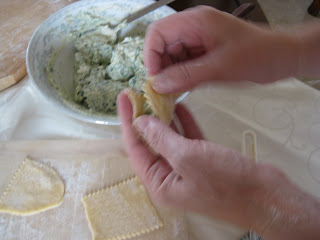


I was so proud when I finally got it right.
It was right before we were about to eat when we realized that we didn't have a sauce to serve with it-- sage butter is a classic accompaniment, but we didn't have any sage (and the thought of melted butter still makes me shudder a little, neurotically), so we decided to make a simple tomato sauce with garlic and canned tomatoes.
Lasagna: Begin by slicing your eggplants (we used four of the skinny, Asian variety), then salt them in a colander to get rid of some of the excess liquid.

When you can see the water droplets on the surface of the eggplant, rinse and dry them (obviously, while the eggplants were sitting there, we were preparing other things-- this isn't an instant process).
The next step is to fry the eggplants-- since eggplant has a reputation of being disgustingly oily (I had a stirfried eggplant the day before yesterday that made me feel nauseous, because by the time I got to the bottom of the bowl, it was just a giant puddle of oil), we tried to use a minimal amount of corn oil and olive oil (at home I would use canola and olive), since using just olive oil would be too strong a taste.
Frying them is pretty self-explanatory... wait until you see golden skillet marks, then put them on a plate between paper towels to drain (We didn't need to cook them TOO well, since we were going to bake them anyway).
The pasta-- again, the same process up until the last step.


Cut the pasta sheets with the tortellini-cutter, only this time you can be much less precise about the shapes, as long as they're slightly longer. This is because even after you've already cut them, you can continue to do so so that they fit the casserole dish you're using, a bit like a jigsaw puzzle. BOIL them before you layer them in the dish!!

For the tomatoes, we just used canned tomatoes-- don't even bother making a sauce. We put a thin layer of tomatoes on the bottom of the dish so that the lasagna wouldn't stick. Next, put a layer of pasta, then a layer of eggplant, then mozzarella, taking care to space them far apart, since we knew they were going to melt all over the place. Continue layering like this until you get to the top, then bake (sorry! forgot the temperature, and either way it was in celsius) for 45 minutes.

Last but not least: the simplest but most delicious apple cake.
At first, Patrizia told me she was making an apple pie, and my mind skipped to my mom's Thanksgiving apple pie: using the food processor to grind up the butter, flour and shortening, refridgerating the dough overnight, rolling it out over plastic wrap, making the filling, making an egg glaze, etc. etc. etc. How could we possibly have enough time to make an apple pie? Then I thought maybe she meant an apple tart, so we would only have to make one crust... then it turned out that we weren't even making anything as complicated as that-- just an apple cake.
Because I have no (good) baking experience and Patrizia wasn't even using a recipe, I must admit I was skeptical at first. But then it turned out to be the most wonderful, light, moist (I HATE THAT WORD but it applies here) cake ever.
ADDED: RECIPE, gotten directly from Patrizia:
Apple cake
about 200 gr flour
about 150 gr white sugar
about 50 gr butter
1 table spoon red sugar (brown sugar, but this is too cute so I have to keep it)
1 tea spoon vanilla concentrate
1 tea spoon baking soda powder
1 lemmon zest (thanks Lida, I learned this new word)
2-3 apples (depending on size)
powder instant yeast (the dose for 500 gr of flour, usually one packaging is the dose for 1, Kg.) so use 1/2 package, my favorite brand is Pan degli Angeli (Angel's Bread) no wonder it's so good
put all the ingrediants in one bowl, liquify the butter in advance, keep a table spoon of butter to grease the baking pan
peel the apples and make cubes
bake about 30 min at 200 degrees Celsius (you make the conversion)
I'm not sure of the weight, but proportions are right.
love
patrizia
In fact, I barely got any photos of the process because it seemed so simple. She combined equal parts flour and sugar in a bowl, added two eggs, a little brown sugar, vanilla, a packet of yeast, and the zest of a lemon, at the same time as melting half a stick of butter over the stove and cutting two apples into chunks. She threw everything together, mixed it, put it in the oven (didn't even preheat it!) for about 30 minutes, and it was done.

THE MEAL: We decided to eat Chinese-style, which I prefer: i.e. rather than eating in courses, we just put EVERYTHING out on the table so everyone could help themselves. This was good, because lasagna and tortelloni aren't traditionally even supposed to be served at the same meal, and I thought eating them one after the other would mean that I wouldn't be able to stomach whichever one we ate second.
Because the dads of both families are Chinese, we had some
xiao chi ("little eats:" appetizers/hors d'oeuvres): spicy cabbage with vinegar, bamboo shoots, and
liang fen (solid blocks of mung bean starch, what glass noodles are made of). We also had a simple salad with a


balsamic vinaigrette.
My mom had bought them a bottle of red wine. I had a tiny amount to go with the fabulous

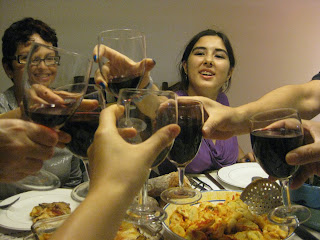
dinner.
Everything was wonderful: the tortelloni really did bring back childhood memories-- they were a little bit too chewy, but perfect for me. the filling was perfect: a little sandy from the ricotta, but pungent from the parmesan. The spinach added more color than taste, but it was so hard to believe that I had
made these!

But what was really the best was the lasagna, although I would have been happy to just eat the eggplant, which was meltingly tender and not too oily at all, on its own. Maybe next time I'll make eggplant parmesan.

The only problem was, after eating not even that much (maybe four tortelloni and a little bit of lasagne), I got one of my
terrible stomache-aches! I actually get stomache-aches daily, and sometimes acid-medicine doesn't help. It usually feels like flames are erupting in my stomach (above my belly-button), and people say they think it's acid, but my mom wants to get me tested for allergies. Please don't let me be allergic to anything I love! I don't think it can be lactose-intolerance, since I drink a lot of milk and eat cottage cheese and yogurt (although lactose-intolerant people can eat yogurt)....
I sampled the cake but wasn't feeling up to having a piece for myself. It really wasn't an apple cake-- while the apples added texture, it was the lemon that overwhelmed it (in a good way). It reminded me of a lemon honey cake, although there was no honey in it.

After dinner, they cracked out the aperatifs, and for some reason, I really wanted to try some. I had tiny sips of amaretto (way too sweet... definitely prefer it in gelato) and limoncello.


It was a great dinner-- for once, I felt like we actually had family friends, something we don't have much of in Chicago. Cooking with Patricia was such a fun experience: she kept muttering in Italian the entire time, and I found I could understand most of it, it being a Romance language (except now I know that
adesso means "now").
Labels: apple cake, cake, china, cooking class, dessert, dinner, eggplant, italian, lasagna, pasta, ricotta, spinach, tortelloni


 the next day to eat for breakfast.


 things are best, especially drenched with lots of vinegar.


 or Japanese meal.


